10 products from trusted UK retailers
90cm induction range cookers pair a fast, easy-clean 5-zone induction hob with two or three electric ovens and a grill, all in one freestanding unit that fits a standard 900mm cooker gap. They suit families, keen cooks and anyone swapping gas for something quicker and cleaner.
Every model here is A rated, from Belling, Stoves and Leisure. Still weighing up hob types? Compare them with our ceramic hob range cookers, or see every 90cm electric range cooker we stock.
A 90cm range cooker is the most popular range size in the UK. It's 30cm wider than a standard cooker, so there's room for a bigger hob and a second or third oven, yet it still slots into an ordinary fitted kitchen. Choose one with an induction hob and you get the fastest, most controllable electric cooking there is.
Induction heats the pan rather than the glass. A magnetic field under each zone makes the base of the pan itself get hot, so water boils quickly and the heat drops the instant you turn the dial down, much like a gas flame. The glass around the pan stays far cooler than a ceramic hob, which means spills don't bake on and a quick wipe is usually all the cleaning it needs.
Underneath, every model in this range is fully electric. You won't need a gas supply or a Gas Safe engineer, just a suitable cooker circuit (more on that below). If you'd still like flames on top, a dual fuel range cooker is the alternative.
Here's how the models in this collection compare. Prices change daily with the retailer, so we've given price bands rather than exact figures. Check the product page for today's price and stock.
| Model | Colours | Hob | Ovens | Total capacity | Oven lining | Guarantee | Price band |
|---|---|---|---|---|---|---|---|
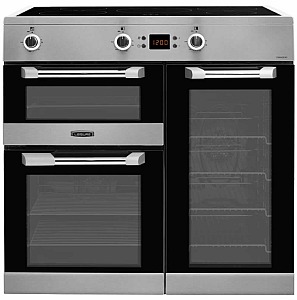
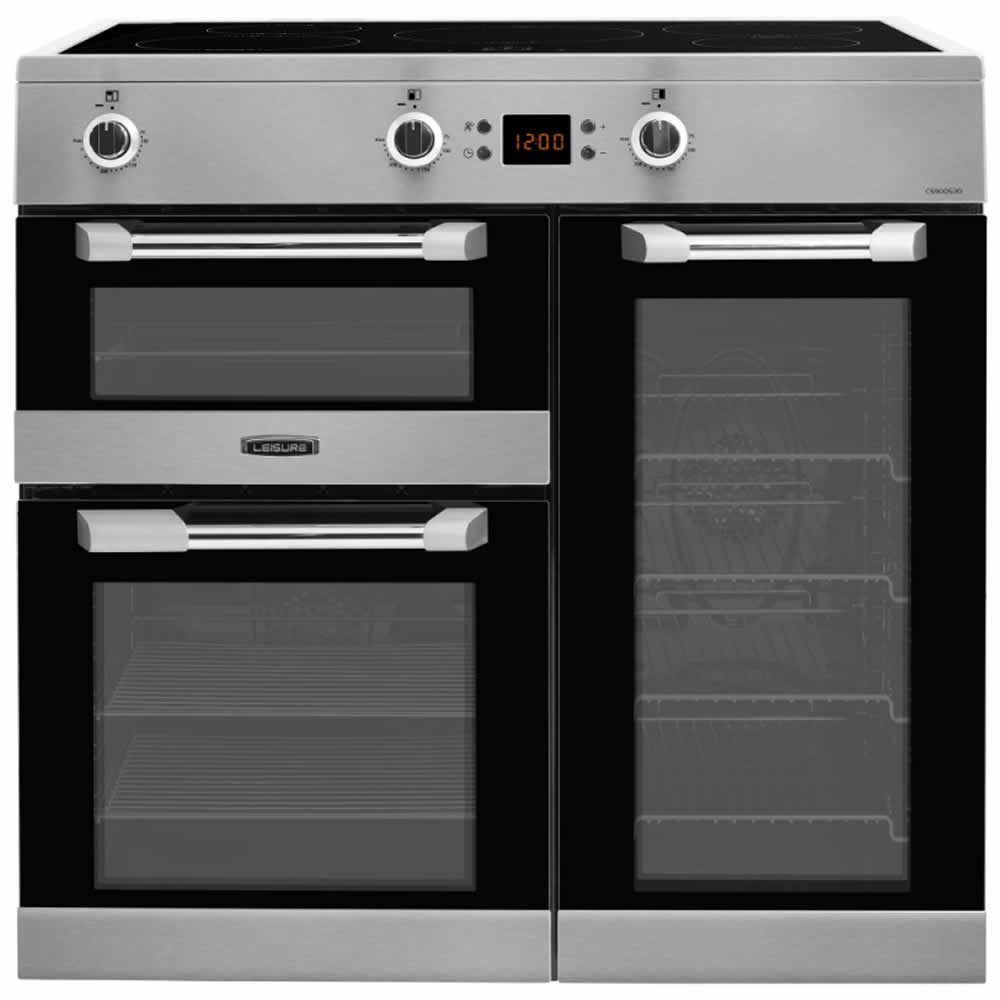
| Leisure Cuisinemaster CS90D530X | Stainless steel | 5-zone induction | Three ovens | About 175 litres | Catalytic | Check at checkout | Around £1,000 to £1,100 |
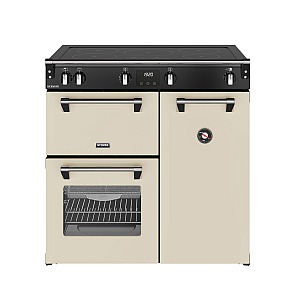
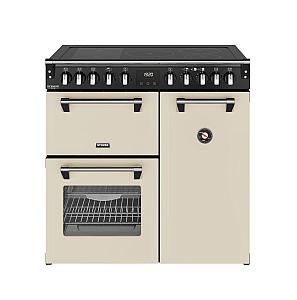
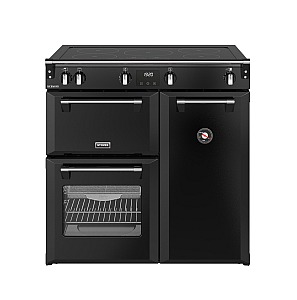
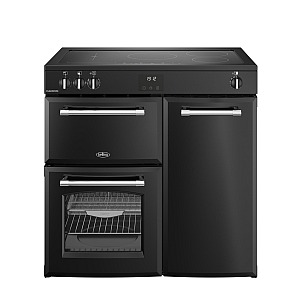
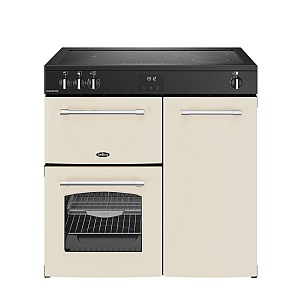
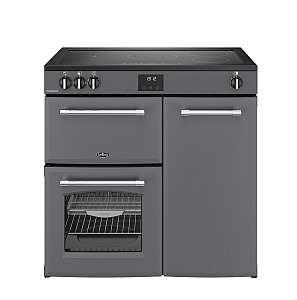
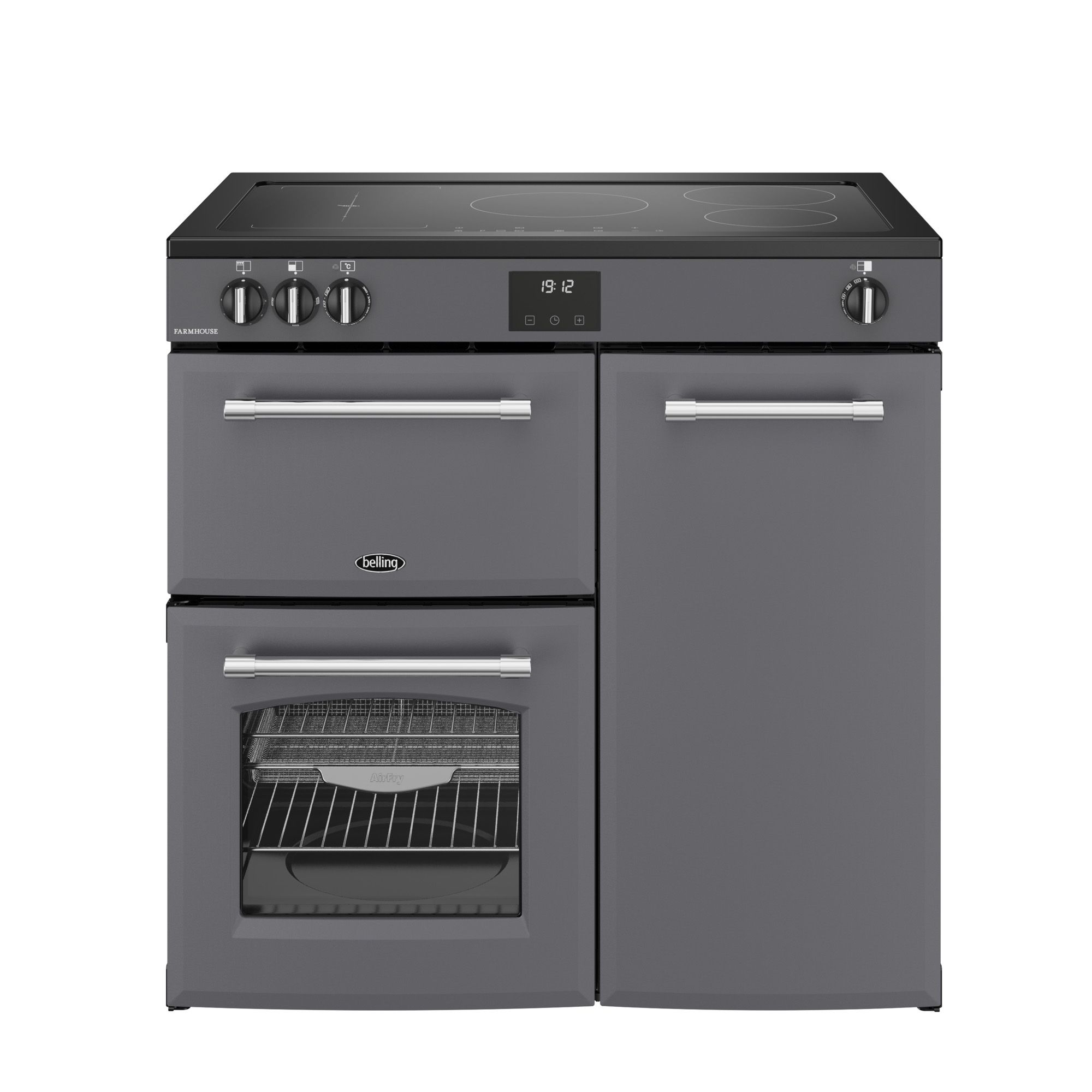
| Belling Farmhouse 90Ei | Black, cream, anthracite | 5-zone induction with Link+ | Two fan ovens plus a separate grill | 174 litres | Enamel | 3 years parts and labour | Around £1,550 to £1,650 |
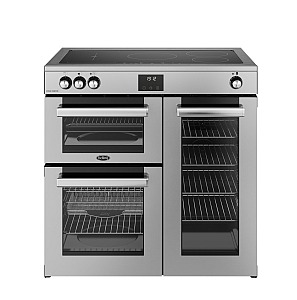
| Belling Cookcentre 90Ei | Stainless steel | 5-zone induction with Link+ | Two fan ovens plus a separate grill | 174 litres | Enamel | 3 years parts and labour | Around £1,550 to £1,650 |
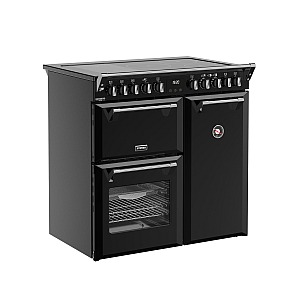
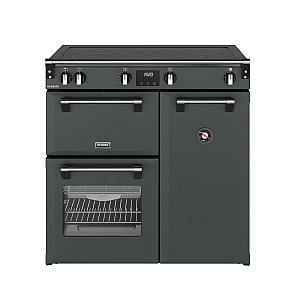
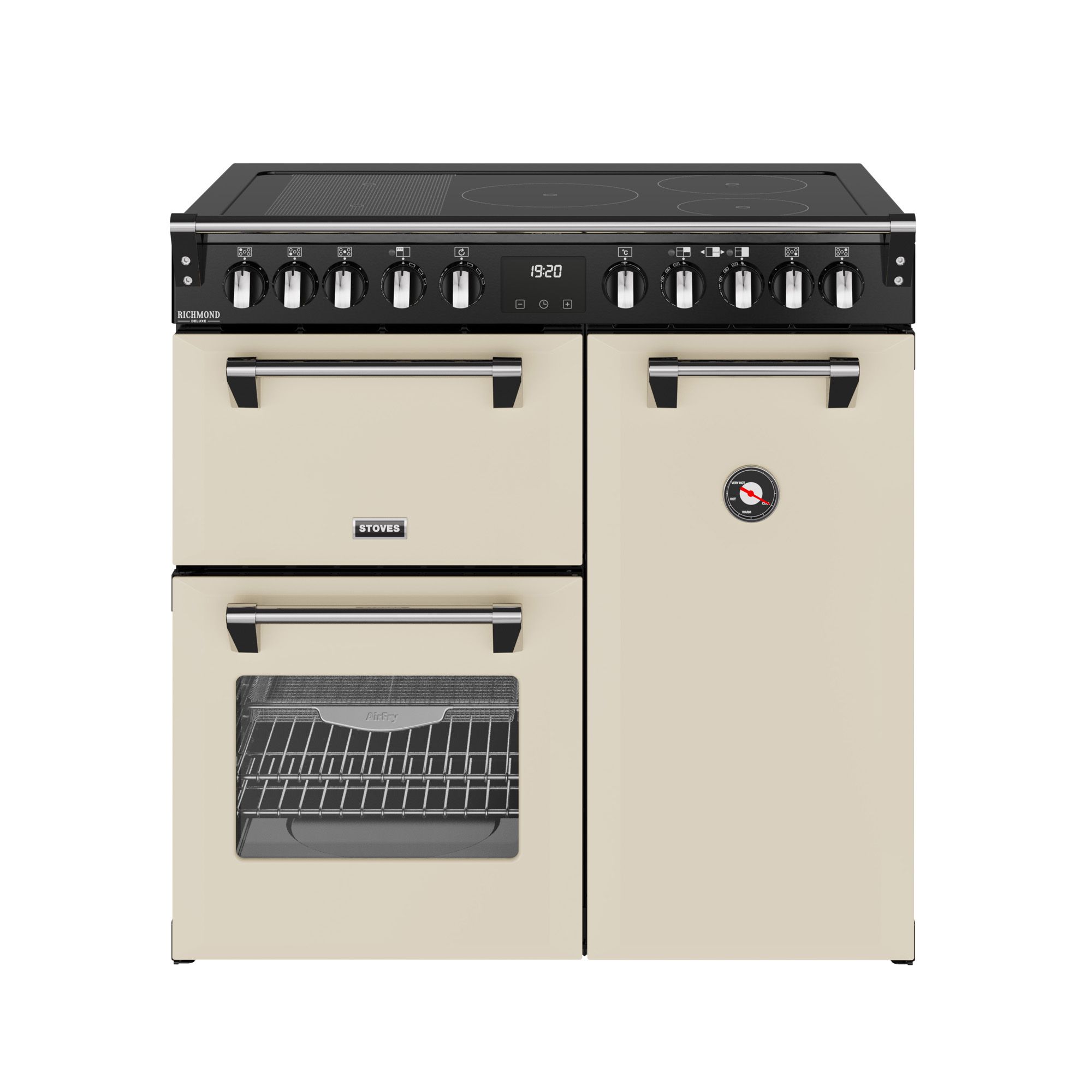
| Stoves Richmond 90Ei | Black, cream, anthracite | 5-zone induction with bridge zone | Three ovens | 174 litres | Enamel | 3 years parts and labour | Around £2,700 to £2,900 |
So all of them have five induction zones and an A energy rating. The real differences are the number of ovens, the look and how much you want to spend.
Every electric induction range cooker looks similar in a product photo, so it pays to compare the details side by side. Run through this list before you order.
Every 90cm induction range cooker in this collection has five cooking zones. That's one more than a typical 60cm hob, and it makes a big difference on a Sunday when the roast potatoes, veg, gravy and custard all need a zone at once.
The zones come in different sizes to suit different pans. Belling's Farmhouse 90Ei spec sheet lists a small 1.2kW zone, three medium 1.8kW zones and a large 2.3kW zone. Each one has a boost setting that lifts it higher for a few minutes (the big zone goes up to 3kW), which is handy for bringing a large pan of pasta water to the boil. There are nine power levels plus boost, so a gentle simmer is just as easy as a fierce sear.
Match cookware to the zone. Too small and it heats less efficiently, far bigger and it heats unevenly towards the edges.
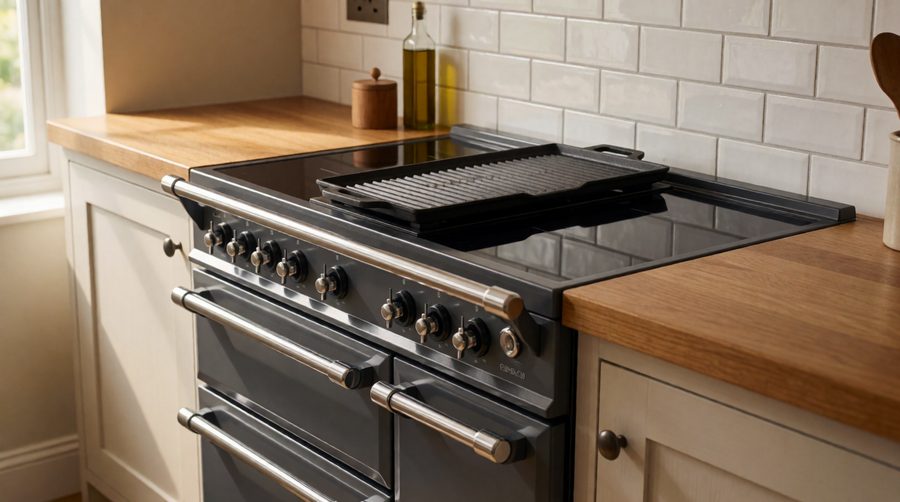
On a 90cm induction hob two zones can usually be joined into one long cooking area. Belling calls it Link+ (the left two zones on the Farmhouse and Cookcentre). Stoves calls it a bridge zone. Link them up and you can heat a cast iron griddle, a fish kettle or a big roasting tin evenly from end to end, as in the photo above.
Induction is one of the safest ways to cook on a hob. The zone only works when it detects a suitable pan, so switching on an empty zone does nothing. The models here add pan detection, pan overheat detection, a child lock and residual heat warnings that show when the glass is still warm from the pan. An automatic stand-by switches the hob off if it's left running for too long. For families with small children, the child lock alone is a good reason to choose induction.
Induction cooking only works with magnetic cookware. The easy test is a fridge magnet. If it sticks firmly to the base of the pan, the pan will work on an induction hob. Cast iron, enamelled cast iron and most stainless steel pans pass. Plain aluminium, copper, glass and ceramic pans won't heat at all unless they have a magnetic plate in the base.
Flat bases matter too. A warped base rocks on the glass, loses contact with the zone and heats unevenly. Most new cookware sets carry an induction symbol (a coil shape) on the box, which saves you guessing.
You may hear a gentle hum or buzz from some pans on high power, especially lightweight or layered ones. It's normal and quietens as you turn the power down. Heavier pans with thick bases tend to be quieter.
This is the part most retailers skip over, and it matters. A 90cm induction range cooker can't plug into a normal socket. It has to be hardwired to its own dedicated cooker circuit, with a cooker switch on the wall.
A 90cm induction range has a big total power load. The Farmhouse 90Ei spec sheet lists a maximum load of 17.3kW with a minimum 32 amp connection. Retailers list the Stoves Richmond 90Ei at around 15.5kW, also on a 32 amp circuit. You'll never draw all of that at once (the hob manages its power between zones), but it means an older cooker circuit wired for a basic ceramic cooker may not be big enough.
Ask a qualified electrician to check your supply before delivery day. Fitting a new circuit is notifiable work under Part P of the Building Regulations, so use a registered electrician who can sign it off. Electrical Safety First has plain-English guidance on kitchen appliance safety if you want to read up first.
Most 90cm range cookers are 896mm to 900mm wide and 600mm deep, with adjustable feet so the hob lines up with your worktop (the Belling Farmhouse 90Ei adjusts from 900mm to 930mm tall). Measure your gap at worktop height and again at the floor, as walls are rarely perfectly straight. A 900mm gap is the minimum.
These cookers are heavy, too. The Farmhouse 90Ei weighs about 86kg out of the box, so measure doorways and hallways and plan for two people to carry it.
Fit a 90cm cooker hood that covers the full width of the hob. Check both manuals for the minimum height (the Farmhouse manual asks for 650mm above the hob). A hood ducted outside clears steam and smells best, but a recirculating hood with carbon filters will do where you can't vent through a wall.
With the induction hob sorted, the number of ovens is your next big choice. Every 90cm range cooker here has at least two, and the extra cavity is what sets a range apart from a standard cooker.
The Belling Farmhouse 90Ei and Cookcentre 90Ei share the same layout. There's a 70 litre fanned main oven (60 litres usable) with several functions including slow cook and air fry, a tall fanned second oven on the other side, and a separate variable grill compartment above. That gives you 174 litres in total. You can roast in one oven, bake in the other at a different temperature and grill the toppings without either oven losing heat.
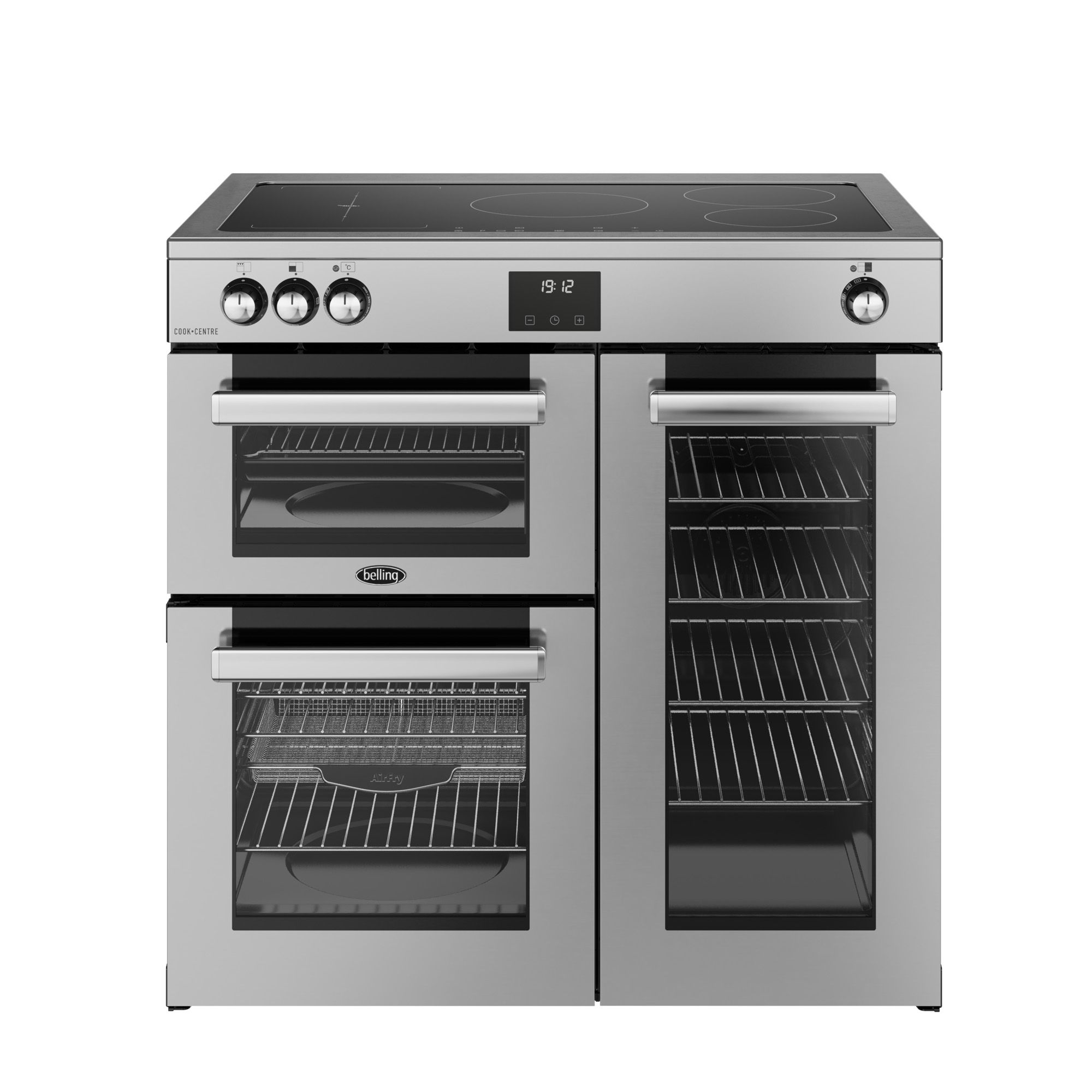
Three ovens suit big families, batch bakers and anyone who hosts Christmas. The Stoves Richmond 90Ei splits its 174 litres across a multifunction main oven with 13 cooking functions, a tall fan oven and a third oven with the grill. It also adds an AirFry setting with its own tray. The Richmond comes in several colours, with a touch control version too. You'll find more widths in our Stoves range cookers collection.
The Leisure Cuisinemaster CS90D530X gives you three ovens and induction for much less money. It has a main fan oven, a tall fan oven and a third oven with the grill, all with catalytic liners and a programmable timer.
A fan oven spreads heat evenly, so every shelf cooks at the same rate. A conventional oven heats from top and bottom elements, giving a hotter top shelf that's ideal for bread, pastry and cakes. A multifunction main oven lets you choose either, plus extras like base heat, defrost and pizza settings.
The flat glass of an induction hob is the easiest hob of all to clean. Because the glass doesn't get as hot as ceramic, boil-overs rarely burn on. Wipe it with a damp cloth once it's cool and use a hob scraper for anything stubborn.
Inside, oven linings make a real difference. Belling and Stoves use smooth enamel that wipes down with a non-scratch cleaner. Leisure uses catalytic liners, which soak up fat and break it down whenever the oven runs hot. Some Smeg models go further with a pyrolytic main oven that heats very high and turns grease to ash you can brush away.
Controls vary too. The Belling ranges pair rotary dials with touch control for the induction zones and a programmable clock that switches an oven off when your dish is done. The Stoves Richmond adds a 13-function main oven and a touch control option.
Every model in this collection carries an A energy rating for its ovens. The rating applies to each cavity, so using the smaller oven for a weekday dinner uses less energy than heating the big main oven.
On top, induction is the most efficient way to cook, because the heat goes straight into the pan rather than warming the glass and the air around it. Which?'s range cooker buying guide is a useful read if you're comparing running costs across hob types. Pop lids on and use the right size zone and you'll save a bit more.
Belling makes most of the 90cm induction range cookers here. The Farmhouse has the traditional range look, with chrome rails and knobs, in three colours, and our Belling Farmhouse range cookers collect every version together. The Cookcentre puts the same ovens and hob in a modern stainless steel body.
Stoves sits a step up in price with three ovens and more cooking functions. Leisure is the budget choice for three ovens. Smeg, Rangemaster and Beko also make 90cm induction models. A few Smeg induction ranges come in and out of stock with our retailer, so they won't always show in the grid above.
Want something more professional looking? Rangemaster's Classic and Professional Plus ranges and Smeg's Classic and Concert models are the big names at the top of the market, many with a pyrolytic main oven that cleans itself. They usually cost more than the models above, but the induction cooker technology underneath works in exactly the same way, so the hob type and number of ovens still matter most.
Pick a colour to suit the room. Cream suits a country or shaker kitchen (see our cream range cookers), black hides fingerprints and looks smart anywhere (black range cookers), and stainless steel gives a professional, chef-style look (stainless steel range cookers). Anthracite, a soft charcoal grey, is a popular middle ground.
Got more room? A wider range brings a bigger hob, sometimes with six zones, and larger ovens. Our 100cm induction range cookers are a modest step up, while 110cm induction range cookers are the largest we stock. To see every width at once, browse all our induction range cookers.
No. A 90cm induction range cooker is hardwired to a dedicated cooker circuit, usually 32 amps, with a cooker switch. A qualified electrician should check the circuit is big enough and make the connection.
Only if your pans aren't magnetic. If a fridge magnet sticks firmly to the base, the pan will work. Cast iron and most stainless steel are fine. Aluminium, copper and glass won't work.
Every model in this collection has five induction zones, with two that can be linked into one long zone for a griddle or fish kettle.
Generally yes. Induction puts heat straight into the pan, so less energy is lost to the glass and the kitchen, and pans come up to temperature faster.
At least 900mm wide and 600mm deep. Most models are around 900mm tall on adjustable feet, so they line up with a standard worktop. Check the manual for any side clearance.
Belling and Stoves give a 3 year parts and labour guarantee on the models here. For other brands, check the product page before you buy.
Most people with a pacemaker can use an induction hob, but the advice varies by device. Ask your cardiac team or check your device's guidance before you buy.