
Range cookers are aspirational purchases, and most owners are glad they bought one. But consumer research consistently finds the same handful of frustrations, and they are not the ones showrooms tend to discuss.
Here they are, roughly in order of how often they come up, along with what you can actually do about each one.
1. It is harder to clean than anything you have owned
This is comfortably the most common complaint, raised by more than a quarter of owners. Two things drive it.
First, the cavities are large and deep, and the back wall of a range cooker oven is a long reach from a kneeling position. Grease bakes hard onto the roof and the rear panel, which are the two surfaces you can least easily get a cloth to.
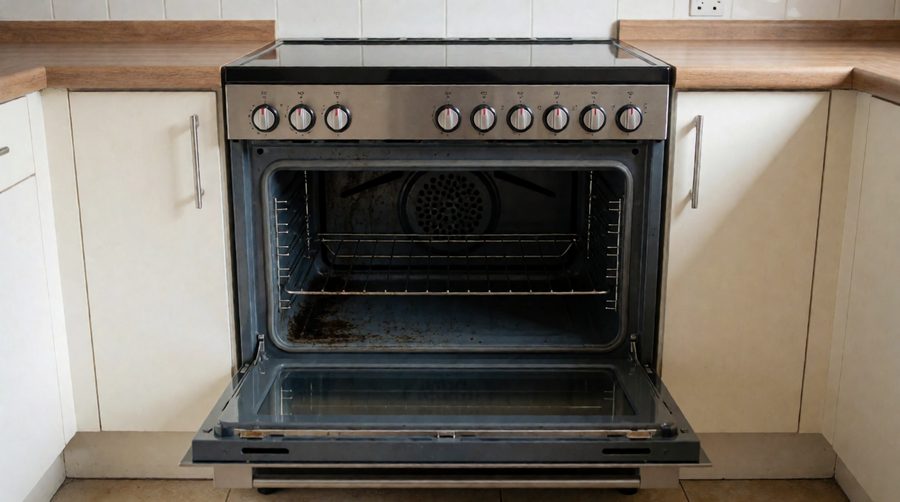
Second, the hob has to be kept clear of baked-on spills. A smooth glass surface wipes flat, which is far less work than lifting heavy pan supports off a traditional hob before you can reach the surface underneath.
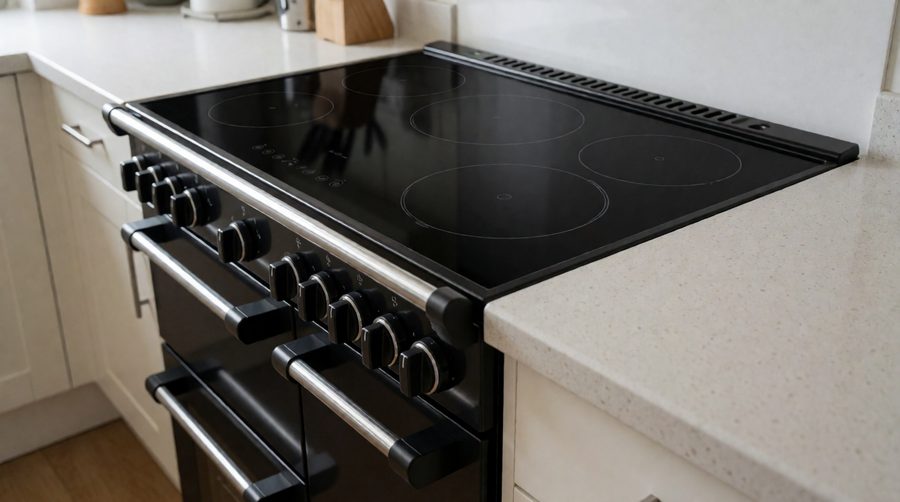
How to avoid it: choose a pyrolytic oven if the budget stretches. It locks and heats to around 500°C, reducing everything inside to ash you wipe out. The alternatives are catalytic liners, which absorb grease but only work above 200°C and eventually need replacing, and plain enamel, which means you clean it yourself.
For the hob, induction and ceramic are both a single flat sheet of glass, so there is nothing to dismantle before you wipe. Our guide to choosing a range cooker hob compares the cleaning burden of each type.
Pyrolytic cleaning is not free of drawbacks
The cycle runs 1–3 hours, costs roughly 60p–£1 in electricity, and produces a distinct burning smell that lingers. Ventilate the room. The fumes are genuinely hazardous to pet birds, whose respiratory systems concentrate airborne toxins, so move them out of the house entirely. It is also the hardest cycle the oven ever runs, and occasionally kills an element or thermostat.
2. The main oven is too low to use comfortably
Around 18% of owners raise this. On a traditional range cooker the main cavity sits low, sometimes with its base only 200–300mm off the floor.
That means bending fully to lift a heavy roasting tin out at arm's length. For anyone with a bad back, dodgy knees, or simply less strength than they had, it is a daily irritation rather than an occasional one.
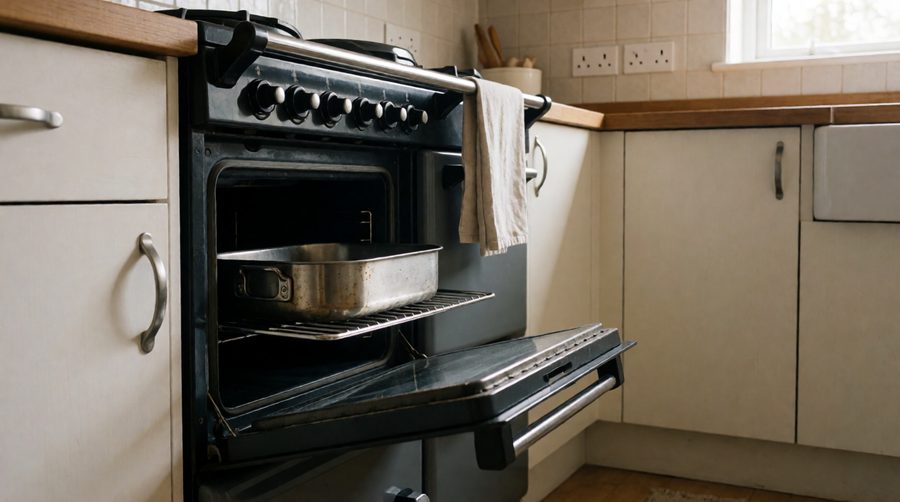
How to avoid it: look at which cavity is the largest. On many 110cm models the biggest oven is one of the upper cavities, not the bottom one, which changes the ergonomics completely. Also check whether the doors are drop-down or side-opening, as side-opening doors let you stand much closer.
If this is a serious concern, a built-in oven at eye level plus a separate hob genuinely is the more comfortable arrangement. It is worth being honest about that before spending the extra.
3. The cooking results are not noticeably better
Only about 30% of owners felt their range cooker delivered notably powerful cooking. Some report that built-in ovens give more consistent results, which feels counterintuitive at the price.
The explanation is usually size. A large cavity takes longer to come up to temperature and holds heat less evenly than a small one, particularly in the corners. A single fan in a wide oven struggles to circulate air uniformly.
| Feature | Why it matters | What to look for |
|---|---|---|
| True fan / fan-assisted | A true fan oven has its own ring element around the fan, giving far more even heat | "Multifunction" or "true fan", not just "fan assisted" |
| Cavity volume | Bigger is not better if you mostly cook for two | 60–75 litres is the practical sweet spot |
| Shelf positions | Few positions means poor control over browning | Four or more |
| Telescopic runners | Lets you pull a shelf out fully without reaching in | Worth having on the lowest cavity especially |
Swipe the table sideways to see every column.
How to avoid it: buy a cheap oven thermometer whatever you choose. Domestic ovens routinely run 10–20°C off their dial, and knowing your oven's true behaviour fixes most "it doesn't cook properly" complaints for about £8.
4. You never use half the features
Three in five owners liked the idea of the versatility. Far fewer actually use the griddle plate, the warming drawer or the slow-cook cavity with any regularity.
These features are what justify the step up from a 90cm to a 110cm model, and they add several hundred pounds. If they sit unused, you have paid for width you did not need and lost worktop space in the process.
How to avoid it: think honestly about how often you cook for more than six people. If the answer is Christmas and the occasional birthday, a 90cm twin-cavity model does everything you need, costs less to buy, and leaves you more worktop. The extra cavity earns its place when you use it weekly, not annually.
5. It cost far more than the cooking it does
Range cookers cost roughly £1,500 more on average than a built-in oven and separate hob, and the difference in annual running costs between the two is about £5.
That is not a reason to avoid one. It is a reason to be clear about what you are buying: presence, capacity, and a kitchen centrepiece. Those are legitimate things to want, but they are aesthetic and practical rather than economic.
If running costs are a concern in their own right, our guide to what an electric range cooker really costs to run works through the actual numbers.
The showroom checklist
- Lift a pan support off with one hand
- Open the lowest oven and reach to the back wall
- Ask which cavity is largest, and whether it is a true fan oven
- Count the shelf positions
- Ask what the cleaning system is, in plain words
- Check the warranty — parts and labour cover often differ
A note on reliability
Elements and fan motors are the components that fail most often on range cookers. The reassuring part is that on established brands they are inexpensive and widely available, and owners routinely report 10 years or more of service with one or two such replacements along the way.
Warranty terms vary more than people expect. Some brands offer one year of labour with five years of parts, others two years of both. Read which is which, because a parts-only guarantee still leaves you paying the engineer.
The short version
- Cleaning is the top complaint — pyrolytic ovens and glass hobs both reduce it
- Low main ovens are a daily strain; check which cavity is largest
- Large cavities cook less evenly, so look for a true fan oven and buy a thermometer
- Extra features often go unused — only pay for a third cavity you will use weekly
- The premium over a built-in is about looks and capacity, not running costs
- Elements and fans are the usual failures, and are cheap on established brands
Read next
Compare with your eyes open
Browse electric range cookers from trusted UK retailers, with cleaning systems, cavity sizes and hob types listed on every model.
Browse Range Cookers