
Ovens get the attention in range cooker marketing, but the hob is what you use three times a day. The choice between induction, ceramic and solid plate changes how quickly you cook, what it costs, what pans you can use, and how long you spend cleaning.
How each one actually works
Solid plate is the oldest technology: a cast iron disc with an element underneath. Cheap, indestructible and slow. It takes several minutes to heat and stays hot long after you switch it off.
Ceramic puts radiant elements under a sheet of toughened glass. The glass heats, and the heat passes into the pan. Faster than solid plate, flat and easy to wipe, and works with any pan that sits flat.
Induction uses an electromagnetic coil to generate heat inside the pan itself. The glass only gets hot from contact with the pan. It is dramatically faster, responds instantly, and is the most efficient of the three by a wide margin.
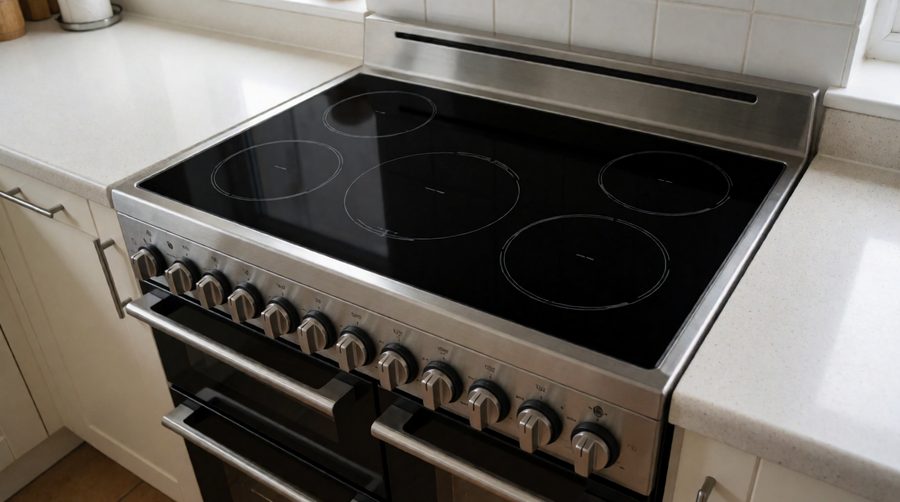
The efficiency figures
Laboratory testing puts the differences starkly. Efficiency here means how much of the energy drawn ends up heating the food.
| Hob type | Efficiency | Time to boil 1 litre | Response to control |
|---|---|---|---|
| Induction | 84 – 90% | 3 – 4 minutes | Instant, like gas |
| Ceramic | 65 – 75% | 6 – 8 minutes | Noticeable lag both ways |
| Solid plate | 55 – 65% | 9 – 12 minutes | Slow; needs planning ahead |
| Gas, for comparison | 40 – 55% | 5 – 7 minutes | Instant |
Swipe the table sideways to see every column.
Induction's advantage is real, but keep it in proportion. Hob cooking is a small share of a household's electricity use, so the saving is measured in tens of pounds a year, not hundreds. We break the numbers down in our guide to range cooker running costs.
The cookware question
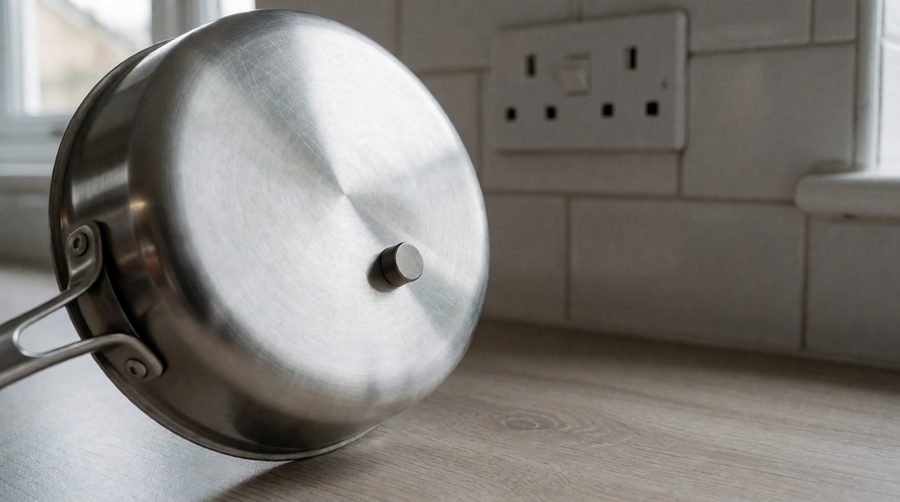
This is the practical catch with induction, and it catches people out. Induction only works with ferromagnetic pans, meaning the base must contain iron or magnetic stainless steel.
The test takes two seconds: hold a fridge magnet against the base. If it grips firmly, the pan works. If it slides off or only weakly attaches, it will not.
| Cookware | Induction | Ceramic | Solid plate |
|---|---|---|---|
| Cast iron, enamelled cast iron | Yes | Yes, with care | Yes |
| Magnetic stainless steel | Yes | Yes | Yes |
| Non-magnetic stainless steel | No | Yes | Yes |
| Aluminium, copper | No (unless clad base) | Yes | Yes |
| Glass, ceramic pans | No | Yes | Yes |
| Warped or heavily domed bases | Poorly | Poorly | Poorly |
Why induction hobs buzz
New induction owners often worry about a humming or buzzing noise. It is almost always the pan, not the hob.
The effect is called magnetostriction: ferromagnetic metal physically vibrates in a rapidly switching magnetic field. Thin, lightweight or multi-ply pans buzz most, especially at high power. Heavy enamelled cast iron is the quietest.
A warped base makes it worse, because the pan is not sitting flush. You may also hear the cooling fan, which runs to keep the electronics cool and sometimes continues after you switch off. Both are normal.
Scratches, and the cast iron problem
Both induction and ceramic use a glass surface, and glass scratches. The usual culprit is cast iron, particularly older pans with rough or chipped bases.
- Lift, never slide. Dragging a heavy pan sideways is how most scratches happen
- Check the base for burrs, chips and built-up carbon, all of which act like sandpaper
- Wipe the glass before cooking — a single grain of grit trapped under a pan does the damage
- Never drop anything on it; glass hobs chip at the edges and a chip can spread
- Deal with sugar spills immediately, even while hot, using a proper hob scraper — sugar etches the glass permanently
Induction hobs and pacemakers
Induction hobs generate an electromagnetic field that can interfere with a pacemaker's ability to sense the heart's electrical activity. The British Heart Foundation advises keeping at least 60cm between the hob and an implanted device. Controlled studies suggest interference is unlikely beyond about 30cm, but the cautious figure is the one to design around. If someone in the household has a pacemaker or ICD, ceramic is the straightforward choice.
So which should you choose?
Choose induction if you cook often and want speed and control, your pans already pass the magnet test or you are happy to replace them, and nobody in the house has a pacemaker. Check the electrical implications too, because a powerful induction hob draws sustained current in a way that affects circuit sizing — see our guide to range cooker electrics.
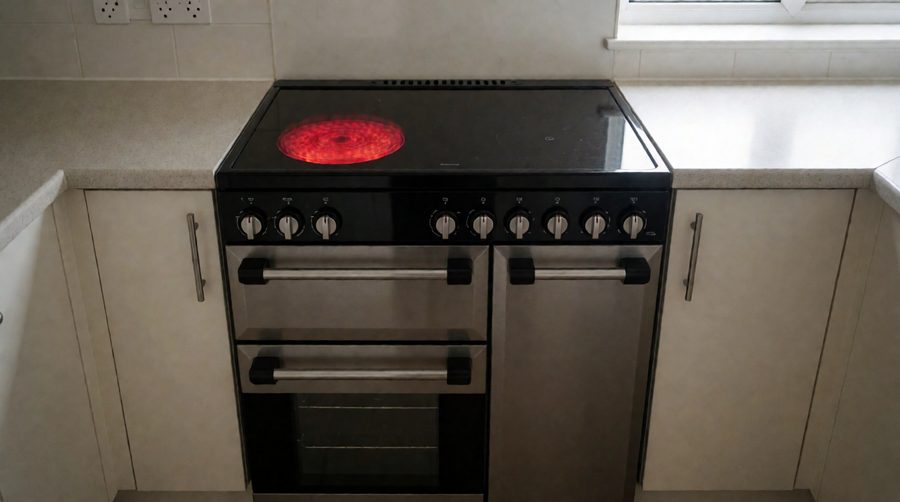
Choose ceramic if you want a flat, easily cleaned surface without replacing cookware, you are working to a tighter budget, or you need to avoid electromagnetic fields. It is the sensible middle option and suits most households well.
Choose solid plate if cost is the deciding factor and the cooker sees light use. It is robust and cheap, but slow enough to be genuinely annoying if you cook daily.
Whichever you pick, the cleaning burden differs enormously, and that is the single biggest source of owner frustration — see the five things owners regret.
The short version
- Induction is 84–90% efficient against 65–75% for ceramic and 55–65% for solid plate
- Test your pans with a fridge magnet before committing to induction
- Buzzing is the pan vibrating, not a fault — heavier pans are quieter
- Lift pans rather than sliding them; sugar spills must be cleared immediately
- Keep 60cm between an induction hob and a pacemaker, or choose ceramic
- Powerful induction hobs may need a larger electrical circuit than you have
Read next
Compare hob types side by side
Browse electric range cookers from trusted UK retailers, filtered by induction, ceramic and solid plate.
Browse Range Cookers