
Nearly every other appliance in your kitchen plugs into a socket. An electric range cooker almost certainly will not, and that single fact is behind more delayed installations, surprise bills and awkward phone calls to electricians than anything else in this guide.
The good news is that the question is easy to answer in advance. You need to know three things: what your new cooker draws, what your existing circuit can carry, and whether the two are compatible. Half an hour with a torch and a tape measure will usually tell you.
Why a 13A plug is not an option
A standard UK three-pin plug is fused at 13 amps. At 230 volts that caps it at roughly 3kW. A 60cm built-in single oven fits inside that budget, which is why some of them genuinely do plug in.
An electric range cooker does not come close. A 90cm model with two ovens and a four-zone hob is typically rated between 9kW and 12kW. A 110cm with three cavities and five zones can reach 15kW or more. That is four or five times what a plug can safely deliver.
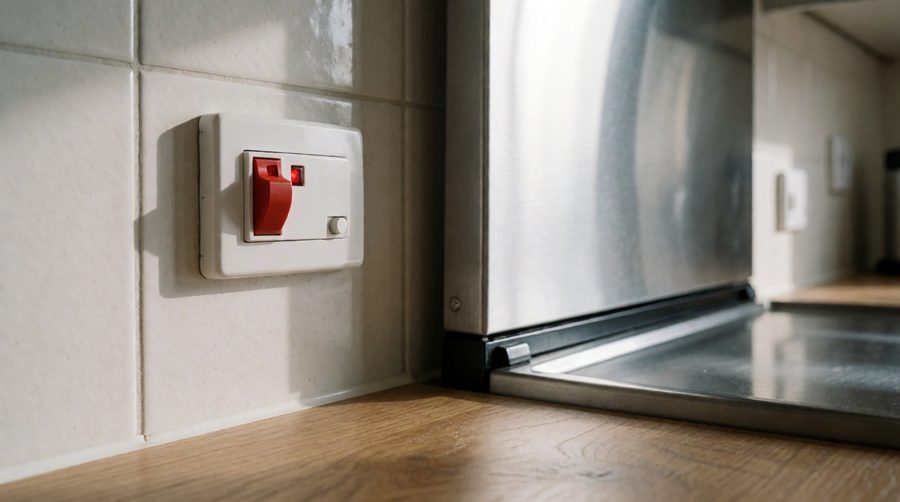
So the cooker is hard-wired instead, into a dedicated radial circuit that runs from its own breaker in the consumer unit to a cooker switch on the wall, and from there to a connection unit behind the appliance.
The diversity rule, and why the numbers look wrong
Here is the part that confuses almost everyone. A 12kW cooker drawing its full load at 230V would pull about 52 amps. Yet electricians routinely put these on a 32A circuit, and they are right to.
The reason is a calculation in BS 7671, the UK wiring regulations, called diversity. It recognises that you never run every oven and every hob zone flat out at the same time for a sustained period. The thermostats cycle, the hob zones pulse, and real-world draw sits far below the badge rating.
The standard domestic cooker calculation works like this:
- The first 10 amps of the rated current at 100%
- The remainder of the rated current at 30%
- Plus 5 amps if the cooker switch includes a 13A socket
Run a 12kW cooker through that and you get roughly 32 amps, which is why 6mm² cable on a 32A breaker has been the standard domestic cooker circuit for decades.
| Cooker rating | Full-load current | After diversity | Typical circuit |
|---|---|---|---|
| 6kW (small, single cavity) | 26A | ~15A | 2.5mm² / 20A |
| 9kW (90cm, twin cavity) | 39A | ~19A | 6mm² / 32A |
| 12kW (110cm, twin cavity) | 52A | ~23A | 6mm² / 32A |
| 15kW (110cm, triple cavity) | 65A | ~27A | 10mm² / 40–45A |
Swipe the table sideways to see every column.
These are illustrative figures, not a substitute for your electrician's own calculation. Cable size also depends on the run length, how the cable is clipped or buried, and the insulation it passes through.
Where diversity stops working: induction
Diversity assumes intermittent, cycling demand. A powerful induction hob breaks that assumption.
Induction is a genuinely efficient way to cook, as covered in our guide to choosing between induction, ceramic and solid plate hobs. But when you run several zones on boost together, it draws close to its full rating continuously rather than in pulses. A hob pulling 7.4kW sustained on a circuit sized for cycling demand can produce genuine problems.
What an undersized circuit actually does
It rarely fails dramatically. Instead you get nuisance tripping that seems to happen only on Sunday lunch, cable running warmer than it should where it is buried, and voltage drop that makes the hob feel sluggish. All three are signs the circuit is working harder than it was designed to.
If your chosen cooker has a high-powered induction hob, ask your electrician to size the circuit on actual sustained load rather than relying on diversity alone. In practice that often means 10mm² cable on a 40A or 45A breaker.
The five questions to answer before you order
- Is there a cooker circuit at all? If the previous cooker was gas, there may be nothing but a gas bayonet and a 13A socket behind it.
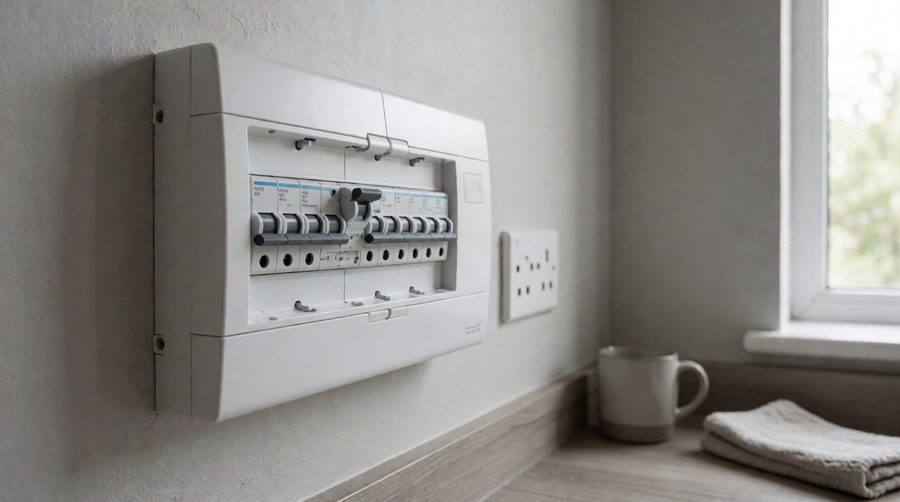
- What is the breaker rated at? Look in the consumer unit for one marked "cooker", usually 32A or 45A.
- What size is the cable? 6mm² is roughly the thickness of a pencil lead per core; 10mm² is noticeably fatter. Your electrician can confirm in seconds.
- Does the cooker switch have a socket in it? The older combined switch-and-socket plates add 5A to the calculation and are best replaced with a plain 45A switch.
- Is the consumer unit modern? An old rewireable fuse board may need upgrading before anyone will add a new circuit, and that is a much bigger job.
What it costs, and who is allowed to do it
Electrical work in a kitchen is notifiable under Part P of the Building Regulations in England and Wales. It must be done by a registered competent person, or inspected and certified by the local authority. This is not optional, and a missing certificate can surface awkwardly when you sell the house.
| Job | Typical cost | Notes |
|---|---|---|
| Connect to an existing, adequate circuit | £60 – £120 | An hour's work plus certification |
| Upgrade 6mm² to 10mm² on the same route | £200 – £400 | More if walls are replastered or floors lifted |
| Install a new cooker circuit from scratch | £300 – £600 | Depends heavily on the cable run |
| Consumer unit replacement | £450 – £900 | Sometimes required before new circuits are added |
Budget for this properly. Retailers, including those we compare, deliver to the room of your choice but do not connect the appliance. That final connection is yours to arrange.
Book the electrician before the delivery
A range cooker weighs 90–150kg. Once it is in position on its levelling feet, moving it again to run a cable is a two-person job. Have the circuit ready and waiting, then the cooker goes in once and stays there.
One last thing about the cable behind the cooker
The cable that emerges from the wall needs enough slack to let the cooker pull forward for cleaning without straining the connection. Ask for the outlet plate to sit low, ideally below 450mm from the floor and offset to one side, so it does not foul the back of the appliance.
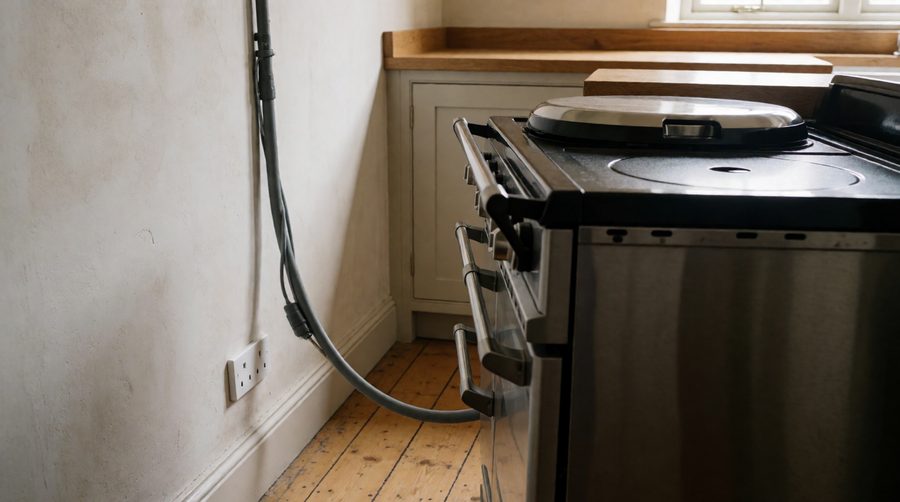
That sounds like a detail, but it interacts directly with how far the cooker sits from the wall, which affects whether it lines up with your worktop. Our guide on measuring up for a range cooker covers the physical side of the same problem.
The short version
- Electric range cookers are hard-wired, not plugged in — a 13A plug tops out around 3kW
- Diversity is why a 12kW cooker legitimately runs on a 32A circuit
- A powerful induction hob breaks that assumption and may need 10mm² on 40–45A
- Check the breaker rating and cable size before you order, not after
- Part P applies, so use a registered electrician and keep the certificate
- Budget £60–£600 depending on whether a suitable circuit already exists
Read next
Ready to compare models?
Browse electric range cookers from trusted UK retailers, with full specifications so you can check the load rating before you buy.
Browse Range Cookers