
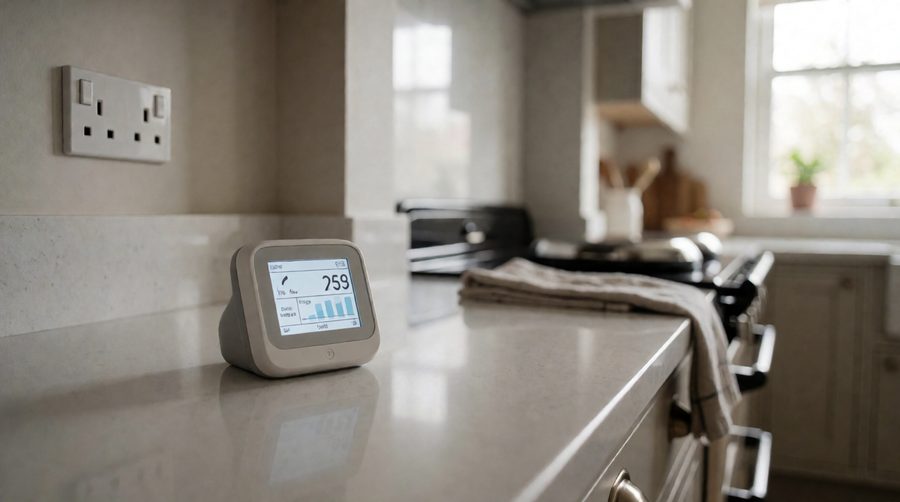
There is no point pretending otherwise: electricity is expensive. At the current price cap, electricity runs at roughly 26.3p per kWh against about 8p for gas. If you are moving from a gas cooker to electric, your cooking costs will go up.
The useful question is by how much, because the honest answer surprises people in both directions. Cooking is a smaller share of a household energy bill than almost anyone guesses.
The basic maths
Everything follows from one calculation: kilowatts × hours × unit rate.
A 2kW oven running for one hour uses 2kWh, which at 26.3p costs about 53p. But an oven only draws full power while heating up. Once it reaches temperature the thermostat cycles the element on and off, and average draw drops to perhaps 30–40% of the rating.
So a 2kW oven at temperature for an hour typically uses nearer 0.9kWh, costing about 24p.
| Task | Energy used | Cost |
|---|---|---|
| Preheating an oven to 200°C | 0.3 – 0.5 kWh | 8 – 13p |
| One hour of baking at 180°C | 0.8 – 1.1 kWh | 21 – 29p |
| A three-hour Sunday roast | 2.5 – 3.5 kWh | 66 – 92p |
| Boiling 1 litre, induction | 0.11 kWh | 3p |
| Boiling 1 litre, ceramic | 0.15 kWh | 4p |
| A pyrolytic cleaning cycle | 2.5 – 4 kWh | 66p – £1.05 |
| Typical household, per year | 300 – 500 kWh | £79 – £132 |
Swipe the table sideways to see every column.
That annual figure is the one worth holding onto. For most households the cooker accounts for somewhere between £80 and £130 a year, which is a small fraction of a total energy bill.
Why the energy label helps less than you would hope
Every electric oven carries an energy rating, and nearly all current range cooker ovens sit at A or above. The scale has been squeezed so tightly that it no longer separates models meaningfully.
Worse, the rating is measured on a standardised test load in a single cavity. It says nothing about how you actually cook, how many cavities you run, or what your hob does, and hob efficiency is not covered by the label at all.
What to look at instead
Compare the kWh per cycle figure in the product specification rather than the letter grade. It is a real measured number, and differences of 0.2–0.3kWh per cycle between models do add up over a few hundred uses a year.
Where the savings actually are
Three things move the needle. The rest is noise.
Use the smallest cavity that does the job
This is the biggest single saving available to a range cooker owner, and it is the main practical argument for a multi-cavity model. Heating a 73-litre main oven to bake a single tray of fish fingers wastes most of the energy on heating air and metal.
A 35-litre secondary cavity doing the same job uses roughly half the energy. Over a year of weeknight cooking that is a genuine £20–£30.
Stop preheating for most things
Preheating matters for bread, cakes, pastry and anything that needs to set quickly. For a casserole, a tray of roast vegetables or a jacket potato, putting the food in cold and adding a few minutes to the time works perfectly well and saves 8–13p every time.
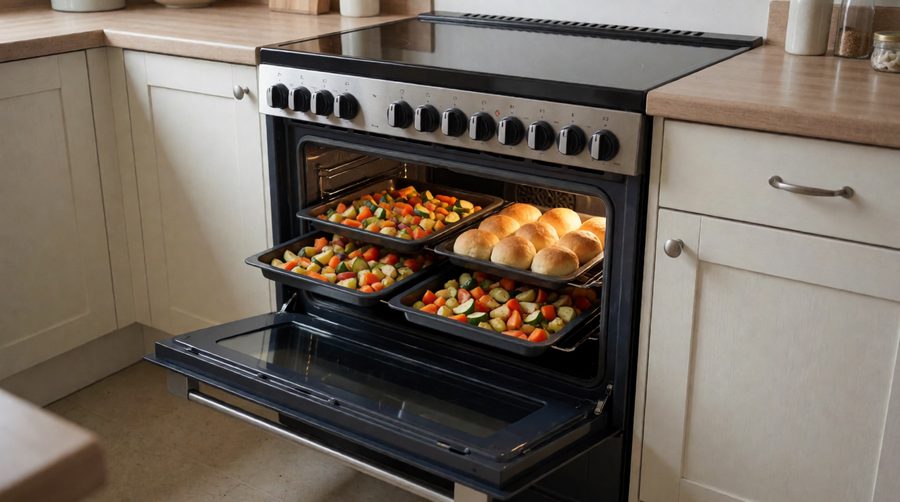
Fill the oven when it is on
The oven costs the same to run whether it holds one tray or three. Batch cooking on a Sunday, or simply roasting tomorrow's vegetables alongside tonight's dinner, is the closest thing to free food energy you will find.
The small stuff, honestly assessed
| Tip | Annual saving | Verdict |
|---|---|---|
| Use the right size hob zone for the pan | £8 – £15 | Worth doing, costs nothing |
| Keep lids on pans | £10 – £20 | Genuinely effective |
| Use a kettle to start boiling water | £5 – £10 | Marginal on induction, useful on ceramic |
| Air fryer for small portions | £20 – £40 | Real, if you would otherwise heat a big oven |
| Keep the oven door glass clean | Negligible | Do it for visibility, not savings |
| Switch off at the wall overnight | £1 – £3 | Barely measurable; resets the clock |
Does induction pay for itself?
An induction hob is 84–90% efficient against 65–75% for ceramic, as covered in our hob comparison. In cash terms that is roughly £15–£30 a year for an average household.
If the induction model costs £200 more, the payback is measured in years, not months. Buy induction for the speed and the control, which are immediately obvious every day, and treat the efficiency as a bonus rather than the business case.
The oven that lies to you
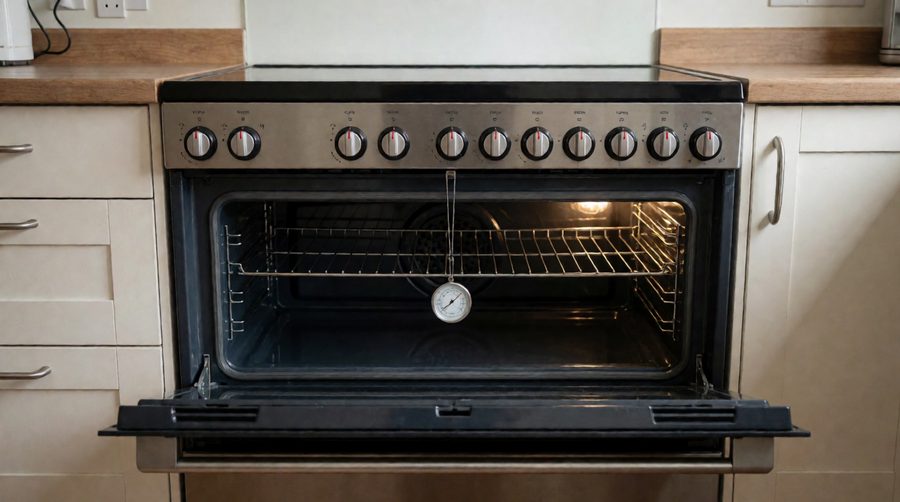
One last thing worth £8. Domestic ovens commonly run 10–20°C away from their dial setting, and a range cooker's large cavities are no exception.
An oven running 15°C hot burns food and makes you cook at lower settings by trial and error. One running cold means everything takes longer, which costs real money over hundreds of uses. A cheap dial thermometer tells you which you have in twenty minutes.
Finally, remember the wider context. The gap in purchase price between a range cooker and a built-in oven with a separate hob is around £1,500, while the running cost difference is roughly £5 a year. Running costs are not the reason to choose one or the other, as we discuss in the five things owners regret.
The short version
- Electricity is about 26.3p/kWh against 8p for gas — electric cooking does cost more
- A typical household spends £80–£130 a year running the cooker
- A Sunday roast costs roughly 66–92p; a pyrolytic clean up to £1.05
- Ignore the A rating and compare kWh per cycle instead
- Using the smallest cavity is the biggest saving available
- Skip preheating for anything that is not baking, and fill the oven when it runs
- Induction saves £15–£30 a year — buy it for the control, not the payback
Read next
Compare energy figures directly
Browse electric range cookers from trusted UK retailers, with specifications listed on every model.
Browse Range Cookers